
A story of innovative geotechnical thinking, terrain-first design, and a solar farm built to outlast anything the Caribbean sky can throw at it.
Some sites push engineers to get creative. The Donoe Solar Farm on St. Thomas, U.S. Virgin Islands, pushed them to get exceptional.
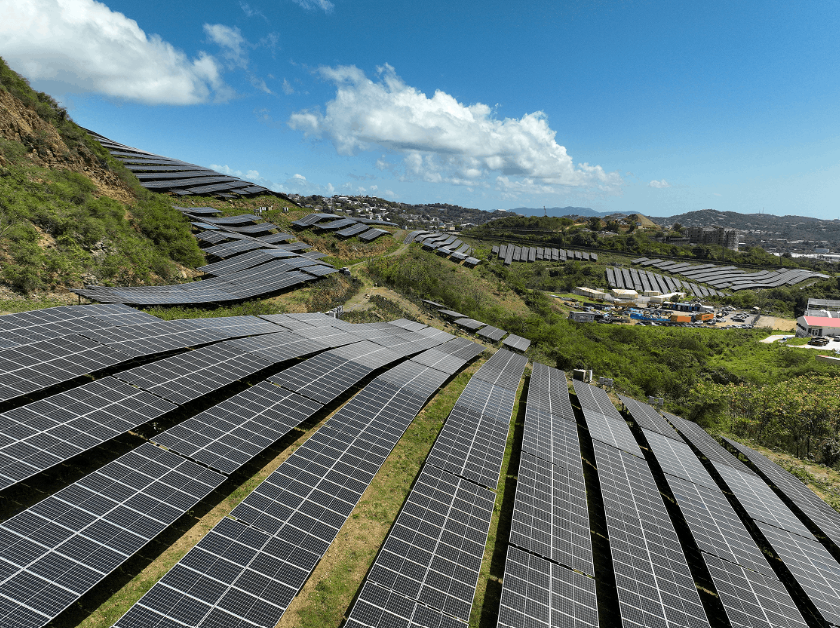
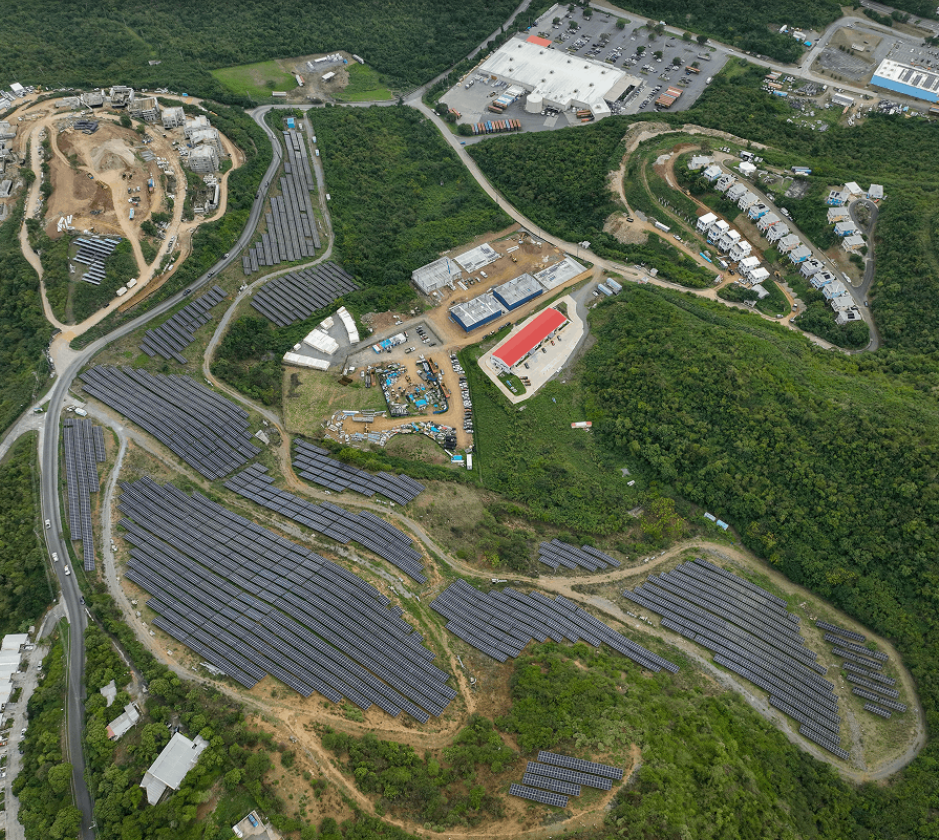
Steep. Coastal. Geologically variable. Subject to category-five hurricane wind loads. For many geotechnical firms, a site like Donoe would prompt a polite conversation about project risk and a quiet step backward. For PRI Engineering, it was exactly the kind of challenge their expertise was built for — and the result is a 6.44 MWdc solar farm that stands as one of the most resilient ground-mount installations in the Caribbean.
A Second Chance Built on the Right Questions
The original Donoe Solar Farm came online in 2015. Two years later, Hurricane Irma — followed by Hurricane Maria — devastated it, along with over 80% of the island’s power infrastructure. When BMR Energy (a Virgin Group company) acquired the site and committed to rebuilding, they made a deliberate choice: this time, the engineering would start at the ground level, literally and figuratively.
That meant bringing in PRI Engineering, a specialist geotechnical engineering firm that had built its reputation designing solar foundations for environments where standard approaches simply don’t hold up — from frost-laden Canadian soils to high-wind coastal zones. The Donoe rebuild was their opportunity to apply that expertise in one of the world’s most demanding solar environments.
The first and most important question they helped answer wasn’t “how do we build this?” It was “why did the previous system fail?” The original facility had used screw piles — a common and typically reliable foundation choice — but they were no match for Irma’s wind loads on this terrain. PRI Engineering and Polar Racking dove into that failure forensically, using the analysis as the foundation (in every sense) for everything that followed.
Going to the Ground: The Site Investigation
In October 2020, PRI Engineering travelled to St. Thomas alongside Polar Racking to conduct a detailed geotechnical investigation and foundation testing plan across the full project footprint. This wasn’t a desk study or a generalised regional assessment — it was boots-on-the-ground, site-specific work designed to understand exactly what Donoe’s terrain would demand.
The site presented every variable a geotechnical team could ask for. The slopes are significant, with elevation changes that affect both how loads transfer through the racking system and how the ground itself behaves under those loads. The coastal environment introduces aggressive corrosion conditions and heightened sensitivity to lateral forces. And the subsurface is heterogeneous — soil types, rock depths, and load-bearing capacities can shift substantially across short horizontal distances.
Rather than treating this variability as a problem, PRI Engineering treated it as a design input. Their investigation mapped where conditions were consistent enough for standard approaches, where site-specific solutions were needed, and what foundation type would perform best in each zone. The result was not one foundation solution but an intelligent, ground-responsive framework — precisely the kind of outcome that separates thorough geotechnical investigation from guesswork.
The Innovation: Driven Piles, Designed for Donoe
One of PRI Engineering’s most consequential contributions was the recommendation to move from screw piles to driven piles — and to specify exactly how those piles needed to be installed for this site. This wasn’t a blanket substitution. It was a data-driven answer to a site-specific problem.
PRI Engineering conducted a full geotechnical exploration and pile pull-out test program to characterise soil conditions across the site and determine the required size and length of piles to properly anchor the system. The result informed a driven pile specification that went significantly deeper than typical installations — at least six feet into the ground — with design parameters validated by testing rather than assumed from generic tables.
What made this genuinely innovative was the coupling of foundation type selection with site-specific load demands. The racking system was being designed to withstand 180 mph wind loads — well beyond standard North American requirements. PRI Engineering’s work ensured the foundations could match that structural ambition: no point engineering a system that can handle 180 mph if the piles holding it to the ground can’t.
PRI Engineering’s approach here reflects a philosophy that defines their solar foundation practice: pre-production testing of piles to verify design assumptions, assess constructability, and develop a clearer picture of subsurface consistency before large-scale installation begins. Test first, build with confidence.
Bringing Expertise from an Unexpected Direction
One of the more interesting dimensions of PRI Engineering’s contribution to Donoe is where their hurricane-design expertise actually came from. Their roots are in northern Canadian solar markets — environments defined by frost heave, deep seasonal freeze, and the enormous uplift forces that come with it.
As PRI Engineering’s own engineers have explained, frost is ultimately a very large uplift load — and so is wind. The physics are different, but the engineering challenge is conceptually similar: designing a foundation system that resists the ground (or the atmosphere) trying to pull the structure upward. A firm that had spent years solving for frost heave in Ontario had, it turned out, developed exactly the geotechnical toolkit needed to design for hurricane uplift in the Caribbean.
That transfer of expertise across climate zones is a genuine innovation in itself — and Donoe is the proof of concept.
Quality Control: Staying Until the Job Was Done Right
Design is a prediction. Construction is where you find out if the prediction holds.
PRI Engineering didn’t hand over a report and return to the office. Their team travelled to St. Thomas to monitor driven pile installation in person and carry out Construction Quality Control throughout the foundation installation phase. Engineers on the ground reported back to the project’s P.Eng., tracking pile depths, installation performance, and subsurface conditions in real time.
This kind of embedded QC matters enormously on a variable site. When ground conditions differ from what the investigation anticipated — and on a heterogeneous site, they sometimes do — having qualified geotechnical personnel on-site means the design can be adapted immediately, before an inconsistency becomes a structural compromise. It is responsive, intelligent construction management, and it reflects a commitment to outcomes rather than just deliverables.
The Terrain-First Philosophy in Practice
What PRI Engineering demonstrated at Donoe is something the solar industry is increasingly recognising as a competitive differentiator: the ability to engineer with the terrain, not against it.
Traditional approaches to challenging sites often default to one of two strategies — flatten the land with earthworks until it resembles an easy site, or force a standard system onto terrain it wasn’t designed for and accept the risk. PRI Engineering’s geotechnical work at Donoe enabled a third path: understand the ground deeply enough to design a foundation system that meets it on its own terms.
This terrain-first philosophy delivered concrete results. By specifying the right foundation solution for each zone of the site and validating those solutions through rigorous testing, PRI Engineering helped the project avoid the redesign delays and civil cost overruns that variable terrain typically produces. The site’s complexity became manageable — not because the terrain was changed, but because the engineering rose to meet it.
What Donoe Proves
The Donoe Solar Farm came back online in 2022, generating approximately 10,400 MWh of clean energy annually for the Virgin Islands Water and Power Authority under a 25-year power purchase agreement. It has reduced the island’s greenhouse gas emissions by an estimated 9,700 metric tonnes of CO₂ equivalent per year — and it is structurally engineered to keep doing so regardless of what Atlantic hurricane seasons bring.
That resilience didn’t happen by accident. It happened because PRI Engineering brought a rigorous, innovative, and genuinely site-responsive approach to some of the most challenging ground conditions a solar project can face.
For developers working with sloped, coastal, or geologically complex sites — increasingly the reality as solar expands into more constrained land — the Donoe project is a compelling demonstration of what expert geotechnical partnership makes possible.
The land doesn’t have to be easy. It just has to be understood.